
Sleep is no longer a simple nightly ritual.
For many, it has become a struggle.
Despite exhaustion, the mind remains active. The body feels wired yet depleted. Even when sleep comes, it is often light, interrupted, or unrefreshing.
Modern life has quietly disrupted one of our most essential biological functions. Constant stimulation, irregular schedules, artificial light, and prolonged screen exposure keep the nervous system in a state of activity long after the day has ended.
To truly understand how to restore sleep, we must first understand what sleep actually is.
What Is Sleep?
From a Modern Scientific Perspective
Sleep is a highly regulated physiological process essential for maintaining homeostasis in the body and mind. It involves coordinated cycles of brain wave activity:
- Gamma / Beta waves – active, stimulated states
- Alpha waves – relaxed awareness
- Theta waves – transitional, pre-sleep states
- Delta waves – deep, restorative sleep
It is during the deeper stages of sleep that the body repairs tissues, regulates hormones, consolidates memory, and restores the nervous system.
From an Ayurvedic Perspective
According to classical texts such as the Caraka Saṃhitā and the Aṣṭāṅga Hṛdayam, sleep (nidrā) is one of the three pillars of life (trayopasthambha).
It is not simply rest—it is a state in which the mind (manas) and senses (indriya) withdraw from external engagement, allowing deep restoration.
Kapha doṣa provides the heaviness that induces sleep, while tamas guṇa allows the system to settle into stillness.
From a Yogic Perspective
In classical texts such as the Haṭha Yoga Pradīpikā, sleep (nidrā) is understood as a natural state of withdrawal and restoration.
When prāṇa is balanced and the mind is no longer outwardly engaged, the system naturally moves toward rest.
Practices such as prāṇāyāma, meditation, and Yoga Nidrā help guide this transition.
Why We’re Not Sleeping
Sleep disturbances rarely arise from a single cause. They are the result of accumulated patterns:
- constant screen exposure and EMF stimulation
- artificial light extending activity beyond natural cycles
- late-night work and irregular schedules
- overactive thinking and emotional overstimulation
- unresolved emotional patterns
- lack of transition between activity and rest
- chronic stress
- excessive travel
From an Ayurvedic perspective, these patterns strongly aggravate Vāta doṣa—the principle governing movement and the nervous system—leading to restlessness, irregular sleep, and a mind that does not settle.
Brain Waves, the Nervous System, and Why Sleep Doesn’t Come
As introduced earlier, the brain naturally moves through different wave states throughout the day—from active, stimulated patterns to slower, more restorative ones.
Sleep is not something we control—it is something the nervous system allows.
In order for sleep to occur, the system must gradually transition into slower, inwardly oriented states.
Modern habits keep many individuals in faster, stimulated states well into the evening, preventing this natural shift.
Even common habits—late work, television watching, emotional stimulation, scrolling, or alcohol—interfere with this process.
While alcohol may initially sedate the system, it disrupts deeper sleep cycles and prevents the body from entering truly restorative states.
The Ayurvedic Clock: Aligning with Natural Rhythms
Āyurveda teaches that the body follows a natural circadian rhythm governed by the movement of the sun and moon, expressed through the doṣas.
The Doṣa Cycle
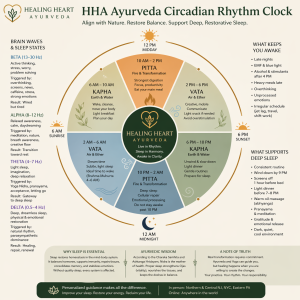
| Time | Doṣa | Qualities | Focus |
| 6 AM – 10 AM | Kapha | Heavy, slow | Wake, movement, light start |
| 10 AM – 2 PM | Pitta | Sharp, focused | Main meal, productivity |
| 2 PM – 6 PM | Vāta | Creative, mobile | Communication, activity |
| 6 PM – 10 PM | Kapha | Calm, grounding | Wind down, prepare for sleep |
| 10 PM – 2 AM | Pitta | Transformative | Deep repair (must be asleep) |
| 2 AM – 6 AM | Vāta | Subtle, light | Dream state, early rising |
Your Circadian Rhythm Is Not Optional
The body operates on rhythm whether we follow it or not.
The Healing Heart Āyurvedic Circadian Rhythm Clock illustrates how these cycles govern digestion, energy, and sleep.
When we align with these rhythms:
- sleep becomes natural
- energy stabilizes
- the nervous system settles
When we override them:
- sleep becomes fragmented
- the system becomes dysregulated
- fatigue accumulates
Āyurveda and Yoga: Sister Sciences of Healing
Āyurveda and Yoga are traditionally regarded as sister sciences.
Āyurveda works through the physical body—regulating agni, the dhātus, and the balance of the doṣas.
Yoga works more deeply through prāṇa, the mind (manas), and the internal patterns that influence rest.
If Āyurveda restores rhythm in the body,
Yoga allows the mind to follow.
How Yoga Supports Restorative Sleep
Rather than inducing sleep directly, Yoga prepares the system for rest.
This may include:
- prāṇāyāma to regulate breath and calm the nervous system
- gentle āsana to release physical tension
- pratyāhāra (withdrawal of the senses)
- Yoga Nidrā to guide the brain toward restorative states
Rhythm Requires Participation
Healing requires participation.
In clinical practice, I have worked with individuals experiencing chronic insomnia—sleeping only a few hours each night while maintaining highly irregular routines.
Without consistent behavioral change, sleep patterns cannot fully restore.
Āyurveda and Yoga provide the framework—but the individual must engage with the process.
The Ayurvedic Approach to Restoring Sleep
Āyurveda does not treat sleep as an isolated issue.
It considers:
- dinācaryā (daily routine)
- agni (digestion)
- nervous system balance
- mental and emotional patterns
The goal is to create the conditions in which sleep naturally arises.
Important Note
Āyurvedic herbs and therapies must be prescribed individually by a qualified Vaidya or advanced practitioner. Self-prescribing is not recommended.
Simple Shifts That Make a Difference
- turn off screens at least one hour before bed
- eat a light dinner before 7–8 PM
- maintain a consistent sleep schedule
- create a dark, quiet environment
- introduce calming evening rituals
Restoring a Healthy Relationship with Sleep
Sleep is not something we control—it is something we allow.
When the body is aligned, the mind is calm, and the nervous system is regulated, sleep arises naturally.
A Final Reflection
In Āyurveda, sleep determines the quality of life—energy, clarity, resilience, and longevity.
When sleep is restored, everything else begins to follow.
Working Together
For those seeking personalized guidance, I work with clients in Northern & Central New Jersey, NYC, Eastern Pennsylvania, and online worldwide.
To explore personalized support, you can book a discovery call here:
https://healingheartayurveda.com/contact-us/