
In today’s fast-moving world, many people feel overwhelmed, exhausted, and disconnected from themselves. The growing interest in wellness retreats reflects a genuine desire to pause, reset, and restore balance.
But there is a deeper question worth asking:
What does it truly mean to heal?
For me, this question is not theoretical. It has been shaped through my own experience of illness, and through witnessing the illness and loss of those closest to me—my parents, my brother, my mentor, and my dearest friend. Each faced different conditions—cancer, heart and lung disease, neurological decline, and AIDS—but what connected them all was the profound human experience of navigating imbalance, vulnerability, and ultimately, the search for peace.
These experiences changed the way I understand healing.
Not as something we fix quickly—but as something we learn to meet with awareness, care, and truth.
After walking through my own experience of illness, I came to understand that healing is not simply about stepping away from life. It is about learning how to return to it differently—with greater awareness, balance, and connection.
Understanding the Different Types of Retreats
All retreats serve a purpose, and each can be valuable depending on where you are in your journey.
Some retreats are designed for relaxation—offering space to unwind and step away from daily stress. Others focus on deepening practices such as Yoga, meditation, or breathwork. Some are centered around cultural immersion and meaningful experiences.
And then there are Ayurvedic healing retreats—which offer something different.
Rather than simply providing rest, they are designed to help you understand the root of imbalance and guide you toward lasting change.
What Makes an Ayurvedic Healing Retreat Different
At its core, Ayurveda is the Science of Life—a complete system that teaches how to live in alignment with your individual constitution and the natural world.
Instead of focusing only on symptoms, Ayurveda asks:
- Why has imbalance occurred?
- What patterns created it?
- How can balance be restored and maintained?
A true Ayurvedic retreat is not only about feeling better—it is about understanding yourself more deeply and learning how to live differently.
Panchakarma: A Deeper Level of Healing
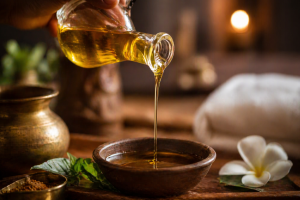
Warm herbal oils are used in traditional Ayurvedic therapies to support detoxification, nourishment, and deep restoration.
One of the most profound aspects of a classical Ayurvedic healing retreat is Panchakarma, a traditional system of purification and rejuvenation practiced in its most authentic form for thousands of years.
This is not simply a cleanse.
Panchakarma is a physician-directed therapeutic process that works at a deep, cellular level to eliminate accumulated toxins, restore the balance of the doshas (Vata, Pitta, Kapha), strengthen the tissues, and support the body’s innate healing intelligence. In Ayurveda, this level of purification is known as Shodhana.
To understand Panchakarma, it is essential to understand the concept of Āma. Āma is not just “toxins,” but a state of incomplete digestion and metabolism—arising from improper diet, weak digestion, chronic stress, or unresolved experiences. Over time, Āma accumulates, obstructs the body’s channels (srotas), disturbs the doshas, and contributes to disease.
According to the Charaka Samhita, when imbalance becomes deeply rooted, it cannot always be corrected through gentle therapies alone. It must be loosened, mobilized, and properly eliminated. This is the role of Panchakarma.
Shamana and Shodhana: Two Paths of Treatment
Ayurveda recognizes two primary approaches:
- Shamana – palliative and balancing therapies that calm and manage the doshas- a pacification procesṣ
- Shodhana – elimination therapies that remove accumulated doshas and toxins- a purification process
Both are essential. Panchakarma belongs to Shodhana, addressing imbalance at its root rather than managing symptoms alone.
The Three Stages of Panchakarma
Authentic Panchakarma unfolds in three carefully guided phases:
a.Purvakarma (Preparation)
The body is prepared through Snehana (oleation) and Swedana (therapeutic sweating), which loosen toxins and bring them into the digestive tract.
b.Pradhana Karma (Main Cleansing)
Individualized elimination therapies are applied based on the person’s constitution and condition.
c.Paschat Karma (Rejuvenation & Integration)
The body is gently rebuilt through diet, herbs, and lifestyle practices to restore strength, digestion, and stability.
The Five Therapeutic Actions
Depending on the individual, Panchakarma may include:
- Vamana – clears excess Kapha
- Virechana – purifies Pitta through the digestive tract
- Vasti – deeply restorative therapy for Vata
- Nasya – clears the head and nervous system
- Raktamokshana – specialized blood purification in select cases
Not every individual undergoes all five therapies. Each program is precisely tailored and guided by experienced Vaidyas ( doctors).
Food as Medicine During Panchakarma
Food is an essential part of the healing process.
Meals are:
- freshly prepared
- easily digestible
- vibrant and nourishing
- full of pranic (life-force) value
- balanced with all six tastes
In certain phases, diet is specifically prescribed in coordination between the Vaidya and kitchen to support the exact stage of healing.
The Role of Yoga in the Healing Process
Yoga is integrated as a supportive practice—not a performance.
Morning sessions reconnect you to the body, while evening pranayama and meditation help integrate the day’s treatments.
All practices are adapted to the individual, ensuring accessibility at every stage of healing.
What Happens After Panchakarma
One of the most important—and often overlooked—aspects of Panchakarma is what happens after the cleansing process.
According to the Charaka Samhita, when Panchakarma is properly performed (Samyak Shodhana), the body and mind begin to express clear signs of restoration:
- enhanced Agni (digestive and metabolic fire)
- a profound sense of lightness in the body and mind
- clarity of thought and perception
- improved stability and nourishment of the tissues (dhatus)
- balanced digestion and elimination
- better sleep and sustained energy
- strengthened immunity
Many people also experience a subtle but powerful shift—a feeling of being more connected, aware, and aligned within themselves. There is a lightness and clarity that take over.
Immediately following treatment, there may be a brief period of fatigue or sensitivity. This is natural. The body has undergone deep cleansing.
With proper post-care—known as Samsarjana Krama—strength and vitality return in a more stable and lasting way.
Healing Continues Beyond the Retreat
A true Ayurvedic retreat does not end when you leave.
During your time there, you begin to understand:
- how imbalance developed
- how your body responds to food, stress, and environment
- what supports your unique constitution
You are given tools and awareness to continue your healing in daily life.
Healing becomes something you participate in—not something that is done to you.
Are Ayurveda or Yoga Religious?
Ayurveda and Yoga are not religious practices.
They are Vedic knowledge-based sciences that can be practiced by anyone.
Who This Experience Is For
This retreat is for individuals at many stages of life and health:
- those experiencing imbalance or chronic conditions
- those feeling depleted or overwhelmed
- those seeking clarity and reconnection
- those ready to take an active role in their healing
No prior experience is required. Everything is personalized.
From Illness to Wholeness
Illness reflects imbalance.
Wholeness reflects connection.
A true healing retreat offers more than rest.
It offers a pathway.
This work is deeply personal to me, shaped not only by study and training, but by witnessing both suffering and the profound possibility of healing.
Call to Explore the Retreat
For those who feel called to experience this work in its most authentic setting, you can learn more about the Healing Heart Ayurveda & Yoga Retreat in Kerala here →https://healingheartayurveda.com/retreats/