
About Ayurveda

Introduction to Ayurveda
Ayurveda is both a natural health system and a profound repository of knowledge. It is based on comprehensive principles that encompass the entire universe – referred to as the “Science of Longevity” or the “Sacred Knowledge of Life.” It provides specific guidelines for preserving and managing human health inextricably linked to the rhythms of nature. Ayurveda emphasizes the profound interrelation relationship between nature and sentient beings, viewing humanity as a microcosm within the vast macrocosm of the universe.
Dietary adjustments
Lifestyle modifications
Understanding and use of circadian rhythms
Natural body therapies
Supplements and herbal remedies
Panchakarma (five-fold detoxification)
Rasayana (rejuvenation)
Yoga, Pranayama, (breathwork), and Meditation
Exercise and activity guidelines
Living environment and climate recommendations
And connecting to nature

A Health Model that Celebrates the Uniqueness of Every Individual
Ayurveda seeks to restore equilibrium and promote overall well-being by recognizing an individual’s “Prakriti” – their intrinsic nature or unique constitution – which involves three essential bioenergetic principles known as “Dosha.” The Doshas govern physiological and psychological functions, with each Dosha associated with specific qualities and elements. These functional principles represent combinations of the five elements found in nature.

Maintaining balance among these Doshas is crucial for health, as imbalances may lead to various physical and mental ailments. Ayurvedic protocols are meticulously designed to harmonize these fundamental Doshas. In Ayurveda, protocols are custom-formulated to realign Tridosha to their rightful positions, instilling a heightened state of balance and well-being in the individual.

What makes Ayurveda Special and different from other sciences?
- Personalized-Respects Uniqueness of the Individual
- Integral-Considers all levels of the individual- body, mind, spirit
- Holistic -Offers natural ways of treating disease and promoting health
- Preventative-Emphasizes prevention
- Empowering-Empowers everyone to take responsibility for their own well-being
- Economic-Cost-effective
- Functional-It works. For thousands of years, Ayurveda’s principles have been successfully applied.
A Brief History of Ayurveda
Ayurveda is a vital part of the Vedic knowledge system, tracing its roots back over 5,000 years when it was revealed to enlightened Indian sages, known as the Rishis. Initially passed along through oral tradition, this sacred wisdom was later compiled into the Vedas, a Sanskrit-based text consisting of four ancient scriptures: the Rig Veda, Yajur Veda, Sama Veda, and Atharva Veda. Ayurveda specifically emerged from the Atharva Veda around 1,000 B.C.
During this historical period, a consortium of ancient scholars formed, gradually supplementing Ayurveda’s ritualistic and mantra-based practices with observations grounded in scientific thinking.
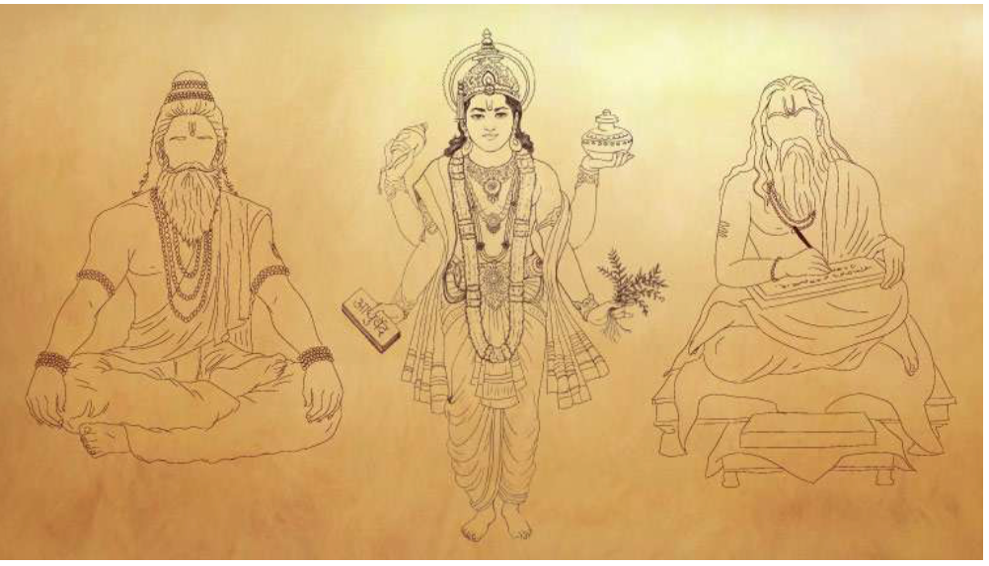
The scattered knowledge found throughout the Vedas underwent a meticulous process of collection, rigorous testing for efficacy, and rearrangement into compilations. Among these, Charaka Samhita, Sushruta Samhita, and Ashtanga Hridayam. These three Samhitas stand out as the oldest, most authentic, and respected Ayurvedic texts, forming the cornerstone of Ayurvedic wisdom.
Between 1000-700 B.C., Ayurveda diversified into eight branches, including General Medicine, Surgery, Pediatrics, Toxicology, Psychiatry, the Science of Rejuvenation, and Vajikarana (the Science of Aphrodisiacs). Concurrently, two schools were established: the Ātreya School of Physicians which focused on General Medicine and the Dhanvantari School of Surgeons.
During the British Colonial Era, Ayurveda faced intense suppression. However, after India gained independence, there was a notable resurgence of Ayurveda, both in India and globally. Recognizing its holistic principles, India revitalized Ayurveda as a significant healthcare system. Today, Ayurveda stands at the forefront of integrated medicine, offering natural and holistic approaches to health and well-being, with a growing global influence and increasing acceptance in Western Society.

The Importance of Ayurveda in Modern Times
Acknowledged by the World Health Organization (WHO) as a comprehensive and natural healthcare system, the relevance and urgency of Ayurvedic knowledge and practices have never been more pronounced.
Our contemporary, rapidly changing world is dominated by technologies that separate us from nature and our cultural origins, living lives that veer towards discord rather than equilibrium. This detachment manifests in a surge of chronic illnesses fueled by persistent stress, which compromises immunity.
Modern medicine, with its ever-escalating costs for medical procedures and pharmaceutical drugs, too frequently lacks personalization and the comprehensive approach to healing, essential for navigating these intricate challenges. The precarious state of our environment further adds to the urgency for a mindful existence on Earth. With its timeless wisdom, Ayurveda emerges as an indispensable guide in meeting the intricate demands of our modern world, providing simple yet powerful solutions to nurture holistic well-being.
What is the Tri-Dosha Theory in Ayurveda
Ayurvedic medicine is rooted in the concept of 5 elements: Space/Plasma , Air, Fire, Water and Earth—resulting in three humors: VĀta, Pitta, and Kapha.
VĀTA-PITTA-KAPHA are functional governing principles in the universe:

VATA– The Principle of Movement (the energy of action, transportation, and movement)

PITTA– The Principle of Transformation (the energy of transformation, conversion, digestion)

KAPHA–The Principle of Cohesion (the energy of construction, adhesion. lubrication, and nourishment)
- Each person has a unique doshic ratio, defining their individual Constitution (Prakriti) and shaping their distinctive makeup. Maintaining balance among the Doshas is crucial for overall physiological, mental, and emotional health.
- Modern medicine focuses on the body’s structure, whereas Ayurveda is based on the energies behind that structure. A structure without function is dead matter; this is why the doshas are studied in Ayurveda.
- Ayurveda aims to preserve Dosha balance through diet, lifestyle, herbal remedies, purification processes, body therapies and yoga.